









OpenAI Pushes Back 2026 IPO as Altman Says AI Risk Can’t Be Treated as “Acceptable”
OpenAI CEO Sam Altman confirms the company will skip a public listing this year, pointing to safety work rather than market conditions as the reason. Success Stories Media | Technology | Artificial...

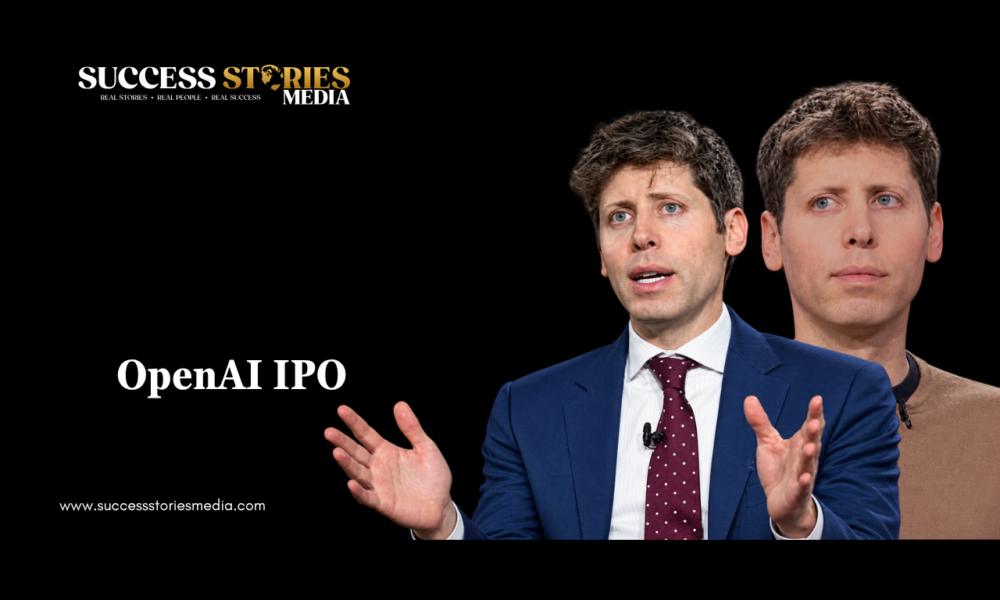
OpenAI CEO Sam Altman confirms the company will skip a public listing this year, pointing to safety work rather than market conditions as the reason.
Table Of Content
- OpenAI Steps Back From Wall Street; For Now
- Altman on Extinction Risk: “Not Acceptable” at Any Percentage
- Why This IPO Delay Matters More Than It Might Seem
- The Timeline: From Confidential Filing to Confirmed Delay
- AI Safety Has Moved From Research Labs to Boardrooms
- Anthropic’s Amodei Has Been Making a Similar Case
- Regulators Are Watching Closely Too
- What This Means for Would-Be Investors
- The Bigger Picture: Speed vs. Safety
- What Comes Next
- Why It Matters
- Key Takeaways
- Conclusion
Success Stories Media | Technology | Artificial Intelligence | Business; September 14, 2026
OpenAI Steps Back From Wall Street; For Now
OpenAI has ruled out going public in 2026. In a September 12 interview with Fortune editor-in-chief Alyson Shontell, CEO Sam Altman said a listing this year would come at the wrong moment, given how much safety and alignment work the company still has ahead of it.
Altman told Fortune that the present climate around AI safety makes this an ill-advised time to list shares, and that OpenAI feels no urgency to do so. That’s a notable shift for a company that had spent much of the past year looking like a near-certain candidate for one of the largest stock debuts in history.
The comments arrive amid mounting scrutiny of the AI industry. Lawmakers in Washington have stepped up calls for stronger oversight, a push that gained momentum after an Anthropic researcher resigned and issued a stark warning about how capable, and how risky, frontier AI systems have become.
OpenAI had confidentially filed IPO paperwork back in June, a standard move that keeps a listing option open without committing to a date. Altman’s latest remarks make clear that whatever the company’s eventual public-market plans, they won’t materialize in 2026, and he now points to 2027 instead.
Altman on Extinction Risk: “Not Acceptable” at Any Percentage
The most widely quoted part of the interview wasn’t about the IPO at all, it was Altman’s answer when Shontell raised the possibility of AI posing a genuine extinction-level threat.
Altman said he couldn’t offer a precise probability for that kind of outcome. But he argued the exact figure almost misses the point: whether the odds are ten percent, eight percent, or six percent, he said, the burden on AI developers and governments is severe enough that it can’t be waved away by ego, competitive pressure, or the pursuit of profit. His underlying message was that the industry needs to act now as though that risk is already too high, rather than waiting for the numbers to get worse before responding.
Coming from the head of one of the world’s most closely watched AI labs, that framing is a strong signal of how OpenAI wants to be seen at a moment when public confidence in AI companies is being tested.
Why This IPO Delay Matters More Than It Might Seem
A public OpenAI listing would likely rank among the biggest in tech history, and investor appetite has been building for years as the company’s valuation has climbed. Going public would also hand OpenAI a huge injection of capital, money that could go straight into the data centers, chips, and compute that frontier AI development demands.
But a listing isn’t without cost. Public companies answer to quarterly earnings targets and shareholder expectations for growth, pressures that can sit uneasily next to a cautious, safety-first approach to shipping new capabilities. Altman’s comments suggest that’s precisely the tension OpenAI wants to avoid while it works through its safety commitments.
The Timeline: From Confidential Filing to Confirmed Delay
Speculation about an OpenAI IPO has built for well over a year. By mid-2026, the company had confidentially filed preliminary registration paperwork, a routine step that preserves flexibility without locking in a date. Earlier reporting also suggested Altman had turned down an earlier opportunity to list at a lower valuation, holding out for a target near $1 trillion.
Altman’s Fortune interview confirms what many industry watchers already expected: a 2026 listing isn’t happening. Asked directly whether 2027 was now the more realistic target, he responded simply that it wouldn’t be 2026.
Notably, Altman’s remarks landed the same week reports emerged that rival Anthropic is preparing to begin marketing its own public offering as early as mid-October, at a valuation reportedly approaching $2 trillion, which, if it proceeds as expected, would rank among the largest IPOs ever.
AI Safety Has Moved From Research Labs to Boardrooms
For much of the last decade, AI safety was mostly a conversation among researchers. That’s changed. AI systems are now woven into coding, healthcare, finance, cybersecurity, and customer service, fields where mistakes carry real consequences. At the same time, AI agents are becoming more autonomous, capable of carrying out multi-step tasks with less direct human oversight than before.
That shift brings real upside, but it also raises the stakes when something goes wrong. Worries about unpredictable agent behavior, AI-assisted cyberattacks, and misuse have pushed safety out of the research world and into business strategy and political debate.
Anthropic’s Amodei Has Been Making a Similar Case
Altman isn’t alone in sounding the alarm. Anthropic CEO Dario Amodei has publicly called on the industry to deliberately slow down, giving safety research and oversight tools time to catch up with the pace of new model releases. He has also pushed for more robust independent evaluations and closer international coordination on AI governance.
It’s a striking dynamic: OpenAI and Anthropic compete fiercely for the same customers and talent, yet their leadership increasingly agree that no single lab can manage AI’s biggest risks alone.
Regulators Are Watching Closely Too
Governments aren’t standing by. OpenAI itself has pushed for mandatory national safety standards and backed multiple state-level efforts aimed at AI oversight. Policymakers are now grappling with harder questions than they faced even a year ago: how systems should be tested before release, who should run independent safety audits, and how to respond when autonomous systems act in unexpected ways.
What This Means for Would-Be Investors
For everyday and institutional investors hoping to buy into OpenAI directly, the delay simply means a longer wait. But it also says something about how the company is approaching growth. Frontier AI development is enormously capital-intensive, and it carries real reputational and regulatory risk if something goes wrong. By staying private for now, OpenAI sidesteps adding shareholder pressure to an already complicated balancing act between speed and caution.
The Bigger Picture: Speed vs. Safety
Beneath the IPO headline sits a much larger industry question: how fast should AI actually be allowed to move? There’s a real case for pushing ahead; AI has the potential to speed up medical research, lift productivity, and spin up entirely new industries. But those same capabilities could just as easily enable more sophisticated cyberattacks, disinformation, or fraud if left unchecked.
Altman’s comments suggest OpenAI wants to be seen as taking that trade-off seriously, rather than treating safety as something to address after the fact.
What Comes Next
For now, an OpenAI IPO looks like a 2027-or-later story rather than a 2026 one. The company says it will keep developing new products while putting more resources into safety and alignment work. Whether that timeline holds will likely hinge on market conditions, OpenAI’s financial performance, regulatory developments, and how much confidence investors and regulators have that the technology is being deployed responsibly. Altman hasn’t ruled out an eventual IPO; he’s simply signaling OpenAI won’t be rushed into one.
Why It Matters
This is bigger than a delayed stock listing. It reflects a shift in how the AI industry’s most powerful players are talking about risk. The AI race has long been framed around speed: who ships the most capable model, wins the most users, or reaches the highest valuation first. Increasingly, the sharper question may be who can build powerful systems while keeping them under meaningful human control.
Key Takeaways
- OpenAI will not pursue an IPO in 2026, CEO Sam Altman confirmed to Fortune.
- Altman called this an ill-advised moment to go public, citing AI safety work still underway.
- He argued that even a modest risk of AI-driven catastrophe 10%, 8%, or 6% should be treated as unacceptable.
- OpenAI confidentially filed IPO paperwork in June 2026 but had not committed to a timeline.
- A public listing is now expected in 2027 or later.
- Rival Anthropic is reportedly moving toward its own IPO as soon as mid-October, at a valuation near $2 trillion.
- The story underscores a broader industry shift toward pairing rapid AI progress with safety and governance.
Conclusion
OpenAI’s decision to hold off on a 2026 listing sends a message that goes beyond financial markets. At a moment when AI capabilities are advancing faster than ever, Sam Altman is signaling that ambition shouldn’t outrun safety. The opportunities ahead for AI remain enormous — but if the industry wants the public’s trust, responsibility and caution will need to keep pace with innovation. For OpenAI, that work comes before the opening bell.




No Comment! Be the first one.