








Green Card Backlog for Indians: Senator Roger Marshall Calls Country Cap “One of America’s Great Injustices.
Introduction The United States Green Card backlog for Indian professionals has returned to the center of Washington’s immigration debate, and this time, a prominent Republican senator is...

Introduction
The United States Green Card backlog for Indian professionals has returned to the center of Washington’s immigration debate, and this time, a prominent Republican senator is leading the charge.
Table Of Content
- Introduction
- What Is the Green Card Country Cap and Why Does It Matter?
- Why Do Indian Professionals Face a 70-Year Green Card Wait?
- Senator Roger Marshall: “The Line Is 70 Years Long Not Because of What You Did”
- The Real-World Impact of the Green Card Backlog
- Indian-Americans: Economic Drivers and Innovation Leaders
- US-India Relations: A Strategic Partnership
- What Congressional Reforms Have Been Proposed?
- What Could Change and When?
- Conclusion
- Frequently Asked Questions (FAQs)
Senator Roger Marshall (R-KS) publicly condemned the US immigration system’s per-country cap at a Capitol Hill event organized by the Foundation for India and Indian Diaspora Studies (FIIDS). He called the situation “one of the great injustices” in American immigration policy, a striking statement at a time when immigration remains one of the country’s most politically charged topics.
His remarks are drawing widespread attention from Indian-American communities, immigration advocates, and policy watchers across the country.
What Is the Green Card Country Cap and Why Does It Matter?
Under current US immigration law, no single country can receive more than 7% of annual employment-based or family-sponsored Green Cards, regardless of population size or applicant volume.
On paper, this rule treats every country equally. In practice, it creates a severe and disproportionate burden for India.
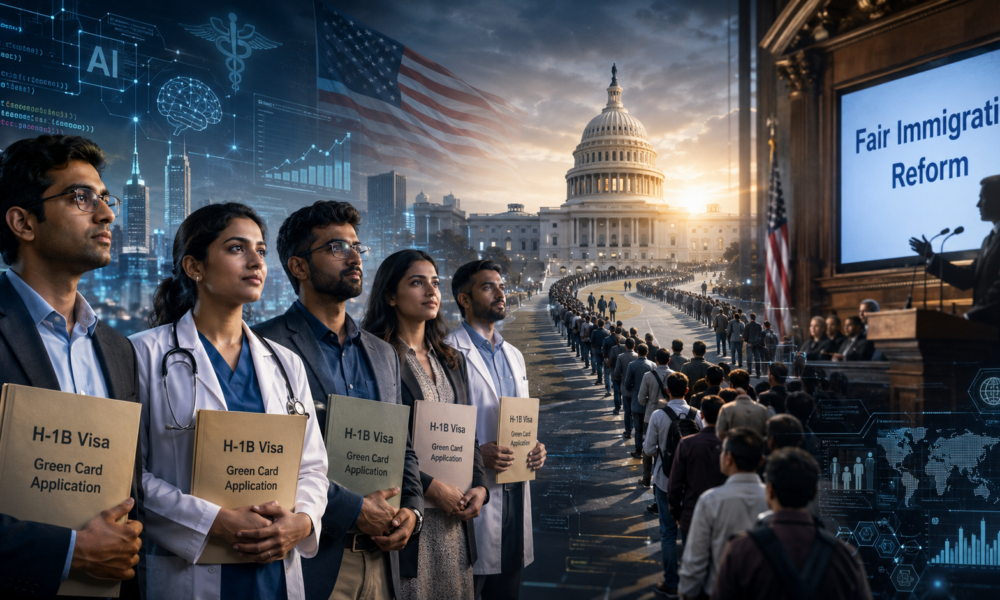
Each year, tens of thousands of Indian professionals, engineers, software developers, doctors, scientists, researchers, and entrepreneurs, enter the United States on H-1B visas and later apply for permanent residency. Because demand from India far outpaces the 7% annual limit, applications pile up year after year, creating one of the longest immigration queues in the world.
Why Do Indian Professionals Face a 70-Year Green Card Wait?
Immigration experts project that applicants entering certain employment-based Green Card categories today could wait several decades for approval with some estimates reaching 70 years if no legislative reforms are enacted.
It is important to understand what this projection actually means:
- The 70-year estimate is a statistical projection, not a garanteed individual timeline.
- It is based on current application volumes, annual visa allocations, and existing per-country limits.
- Actual wait times may be shorter if applicants withdraw, leave the US, or if immigration laws change.
- The figure represents a worst-case scenario under the current system — but for many applicants, the wait is already measured in decades, not years.
For hundreds of thousands of Indian professionals currently living and working in the US, this uncertainty touches every major life decision: career changes, home purchases, family planning, and long-term financial security.
Senator Roger Marshall: “The Line Is 70 Years Long Not Because of What You Did”
Speaking directly to the Indian-American community at the FIIDS event, Senator Marshall did not mince words:
“We are telling the world’s hardest-working immigrants that the line is 70 years long not because of what you did, but because too many of you came from the same place.”
Marshall argued that employment-based immigration should reward talent, skills, and economic contribution — not penalize applicants based on their country of birth. He described the country cap as an outdated rule that fails to reflect the realities of a modern, globalized economy.
He also praised Indian-Americans for their outsized contributions to the United States:
“Every time someone in Washington questions whether legal immigration works, you’re the answer. You’re not the argument; you’re the answer.”
Marshall pledged to continue pushing for practical, legal reforms to reduce the backlog a significant statement from a Republican lawmaker at a time when immigration policy remains deeply divisive.
The Real-World Impact of the Green Card Backlog
For Indian H-1B visa holders, the Green Card backlog is not just a bureaucratic inconvenience. It affects nearly every aspect of daily life:
Career Constraints
H-1B holders are tied to their sponsoring employer. Changing jobs while waiting for a Green Card can mean restarting the process or losing years of progress in the queue.
Financial Uncertainty
Long-term financial planning mortgages, investments, retirement savings becomes far more complicated without permanent residency status.
Family Stability
Spouses and children on dependent visas face their own restrictions. Adult children of H-1B holders can “age out” of dependent status while waiting.
Constant Visa Renewals
Many professionals spend years sometimes decades renewing temporary visas, creating a cycle of administrative stress and legal fees.
Pathway to Citizenship Delayed
A Green Card is a prerequisite for US citizenship. Delays in permanent residency push back naturalization by years or decades.
Indian-Americans: Economic Drivers and Innovation Leaders
Senator Marshall’s praise for the Indian-American community reflects a well-documented reality: Indian immigrants and their descendants are among the highest-contributing demographic groups in the United States.
Though they represent a small percentage of the total US population, Indian-Americans are leaders across:
- Technology and Software Engineering A significant share of Silicon Valley startups are founded by entrepreneurs of Indian origin.
- Healthcare and Medicine Indian-American physicians serve patients in communities across the country, including rural and underserved areas.
- Artificial Intelligence and Research Indian professionals are at the forefront of AI development, academic research, and scientific innovation.
- Finance and Business Indian-origin executives lead major US corporations, including several Fortune 500 companies.
- Entrepreneurship Indian-Americans have founded or co-founded companies that collectively generate billions in annual revenue and support thousands of American jobs.
Marshall’s remarks underscore a growing bipartisan recognition that skilled legal immigrants particularly those from India are a net economic asset to the United States.
US-India Relations: A Strategic Partnership
Beyond the immigration debate, Marshall also highlighted the broader strategic importance of the US-India relationship.
He noted that stronger bilateral cooperation benefits both nations across multiple dimensions:
- American agricultural exports gain access to India’s massive consumer market.
- Technology and defense partnerships continue to deepen.
- Democratic cooperation strengthens stability in the Indo-Pacific region.
- Trade relationships create economic benefits on both sides.
His comments align with a broader foreign policy consensus that India is one of the United States’ most important strategic partners in the 21st century making the treatment of Indian immigrants not just a domestic policy issue, but a matter of diplomatic significance.
What Congressional Reforms Have Been Proposed?
The Green Card backlog is not a new issue. Lawmakers from both parties have introduced various reform proposals over the years, including:
- Eliminating or raising the 7% per-country cap on employment-based Green Cards
- Expanding annual Green Card numbers across all employment-based categories
- Recapturing unused visa numbers from previous years
- Modernizing the employment-based immigration system to better reflect workforce demand
Despite years of debate and numerous legislative proposals, no comprehensive reform has yet been signed into law. Political disagreements over broader immigration policy have repeatedly stalled progress on even targeted reforms with bipartisan support.
What Could Change and When?
Whether Congress will act on Green Card reform in the near term remains uncertain.
Immigration legislation is notoriously difficult to pass because it requires balancing a wide range of competing priorities: economic needs, labor market dynamics, national security concerns, and political pressures from multiple directions.
However, there are reasons for cautious optimism:
- Senator Marshall’s public stance signals that Republican support for skilled immigration reform may be growing.
- The Indian-American community’s increasing political engagement is drawing more attention to the issue in Washington.
- Business and technology industry groups continue to advocate for reforms that would ease the backlog.
- Bipartisan momentum, while fragile, has existed before and could re-emerge.
For now, millions of skilled professionals from India continue to wait contributing to the American economy while remaining uncertain about their long-term futures in the country they call home.
Conclusion
Senator Roger Marshall’s decision to speak out against the Green Card country cap represents a meaningful moment in the ongoing immigration debate. By calling the system unfair and recognizing the immense value that Indian professionals bring to the United States, he has added a prominent Republican voice to a cause that has long been championed by immigration advocates and the Indian-American community.
The 70-year Green Card backlog is not simply a bureaucratic statistic. It is a lived reality for hundreds of thousands of families professionals who have built careers, raised children, paid taxes, and contributed to American innovation, all while waiting for a system to recognize their permanent place in this country.
Whether Washington will finally act on meaningful reform remains to be seen. But with voices like Marshall’s entering the conversation, the push for a fairer, merit-based immigration system is gaining new momentum.
Frequently Asked Questions (FAQs)
Why do Indians face such long Green Card waiting times?
US immigration law caps each country at 7% of annual employment-based Green Cards. Because demand from India is extraordinarily high driven by large numbers of H-1B visa holders the backlog grows faster than it can be cleared.
What is the Green Card country cap?
A per-country limit that restricts any single nation from receiving more than 7% of family-sponsored and employment-based Green Cards issued each year, regardless of population size or applicant volume.
Did Senator Roger Marshall call for removing the country cap?
Marshall criticized the country cap as unfair and pledged to advocate for practical and legal reforms to address the backlog. He did not specify a single legislative solution but made clear his support for change.
Is the 70-year Green Card wait real?
The 70-year figure is a long-range projection based on current application volumes and existing law. It is not a guaranteed individual timeline. Actual wait times vary and may improve if Congress enacts reforms.
Why are Indian professionals so important to the US economy?
Indian professionals are leaders in technology, healthcare, engineering, AI, finance, and entrepreneurship. They found companies, pay substantial taxes, create jobs, and drive innovation across multiple industries critical to the US economy.
Can Congress fix the Green Card backlog?
Yes. Congress has full authority to raise or eliminate per-country caps, increase annual Green Card numbers, and recapture unused visas. The challenge is political will, not legal ability.







No Comment! Be the first one.